
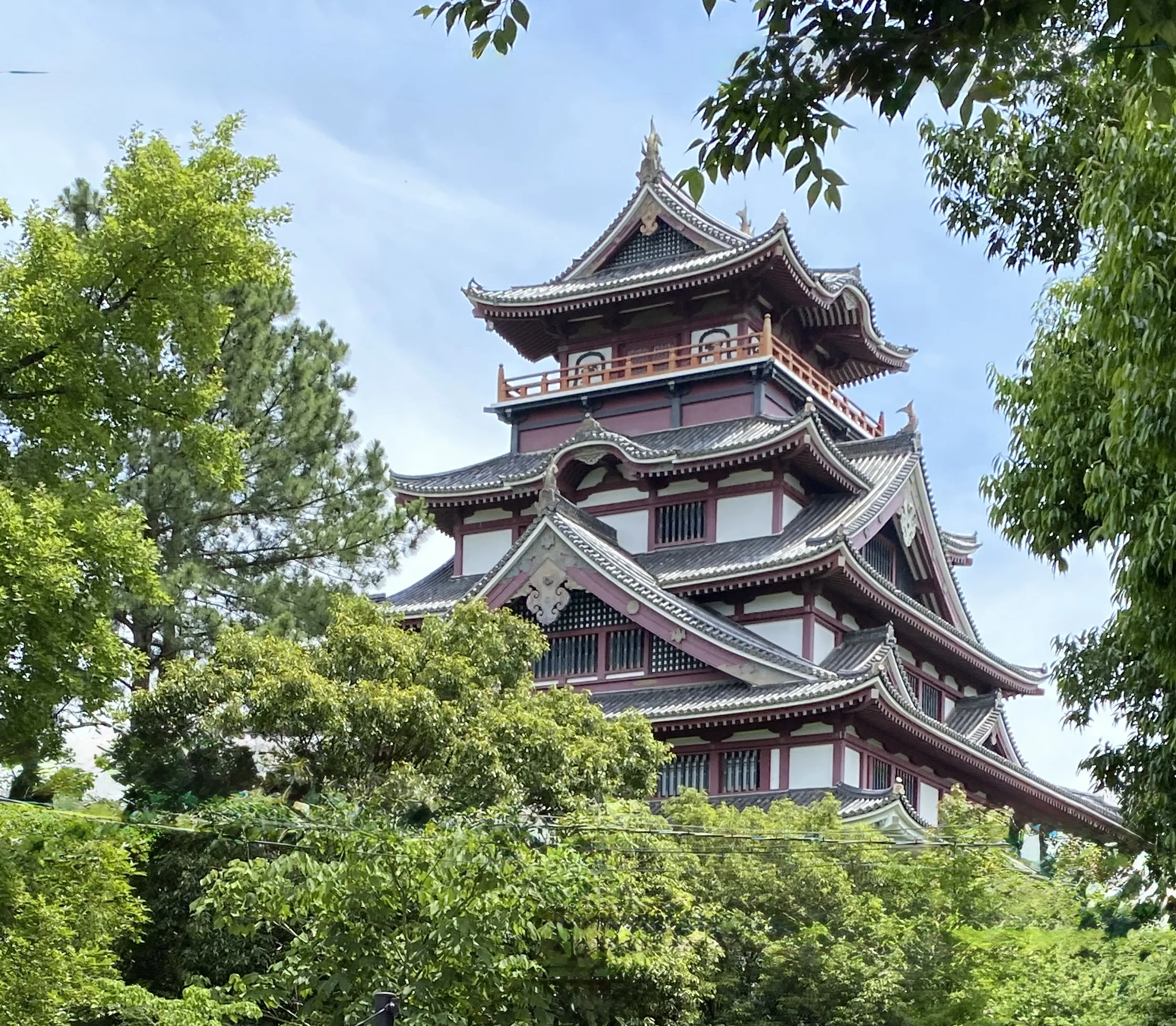
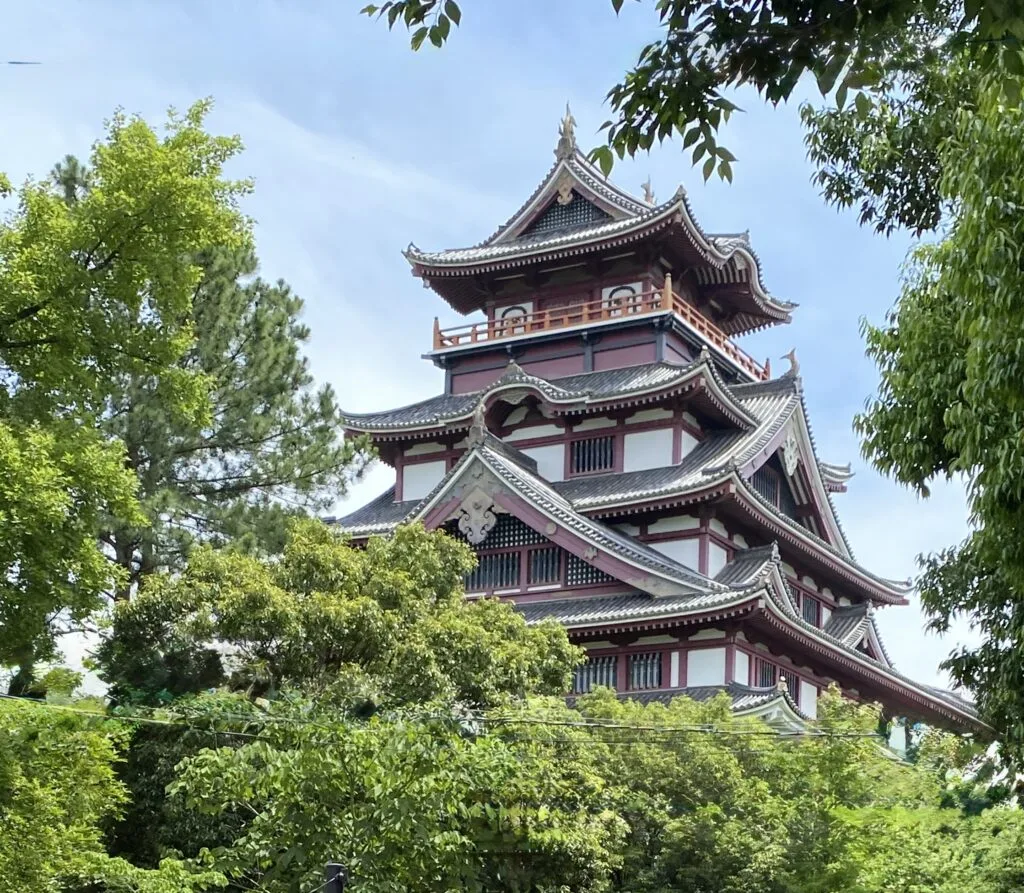
Many heading south from Kyoto notice the castle poking out above the final reaches of the Higashiyama range. This pair of castle keeps were built in 1964 to commemorate the old Fushimi Momoyama castle. In conjunction with the 50th anniversary of their construction in 2014, the Kyoto Isshū Trail was extended an additional 9.5 kilometers, to pass just beneath the towers.
I’d already walked this new Fushimi-Fukakusa Course, not long after it opened, moving from south to north to connect with the Higashiyama Trail within the grounds of Fushimi Inari shrine. But as the near unbroken chain of warm February days seemed to indicate the arrival of spring, the trail allowed for a few hours spent outdoors.
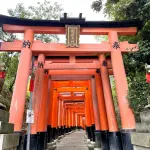
I decided to walk it in the opposite direction this time, in order to finish with lunch in Fushimi town. One has the option of starting from either of Fushimi Inari’s train stations, and I recommend turning left at the top of the steps beside the shrine’s Honden, in order to avoid the social media scrum shooting photos where the massive torii gates begin. Far better to take the quieter path that leads past Inari Saryo cafe, continuing to follow this main path as it weaves around toward Ippon-sugi. Where the row of torii crosses the path, turn right to enter them, moving against the flow of tourist traffic for about 20 meters until a path opens up on the left, with a post for the Kyoto Isshū Trail, marked 2-2.
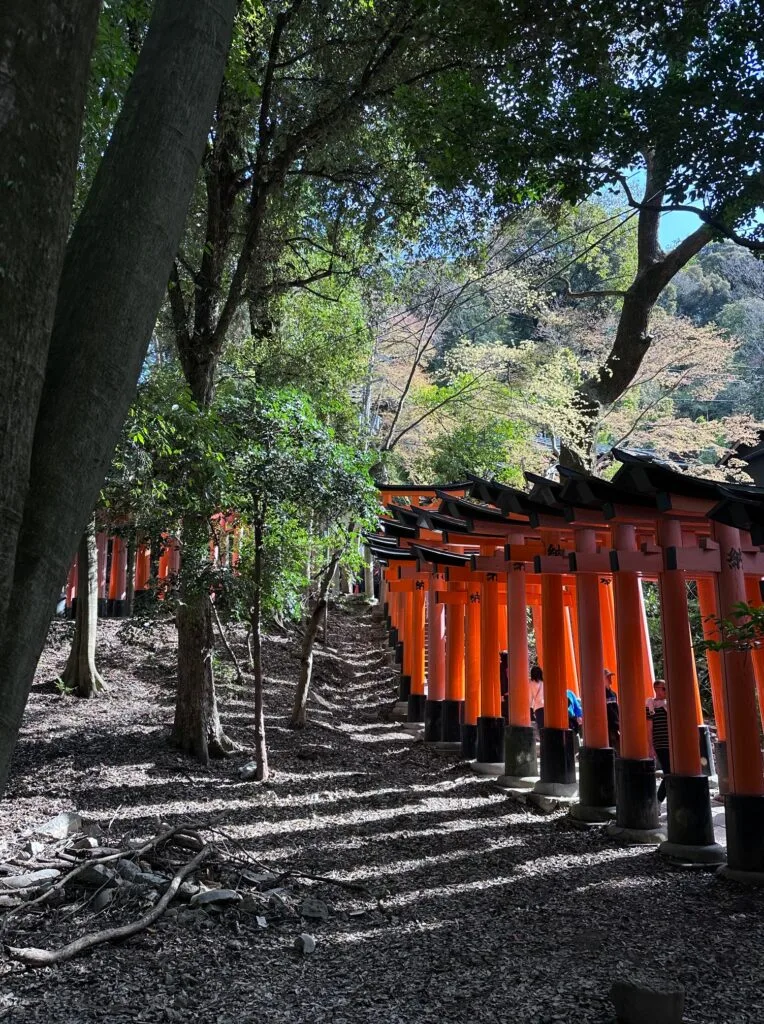
This dirt path climbs into the forest proper, leaving nearly all the visitors behind. Passing a quiet small shrine atop the rise, I found myself walking along a ridge top, through a picturesque bamboo forest.
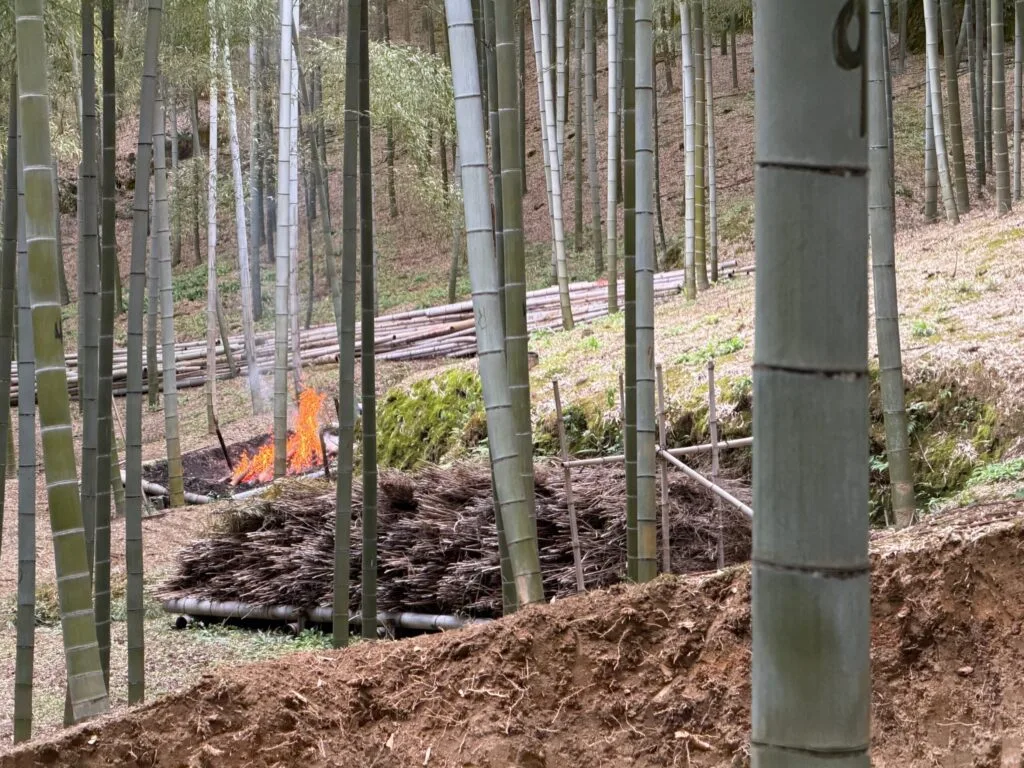
Today, a pair of workmen were busy cutting trees, burning off what they’d felled. Air bursts from within the bamboo’s sealed chambers echoed through the forest like gunfire.
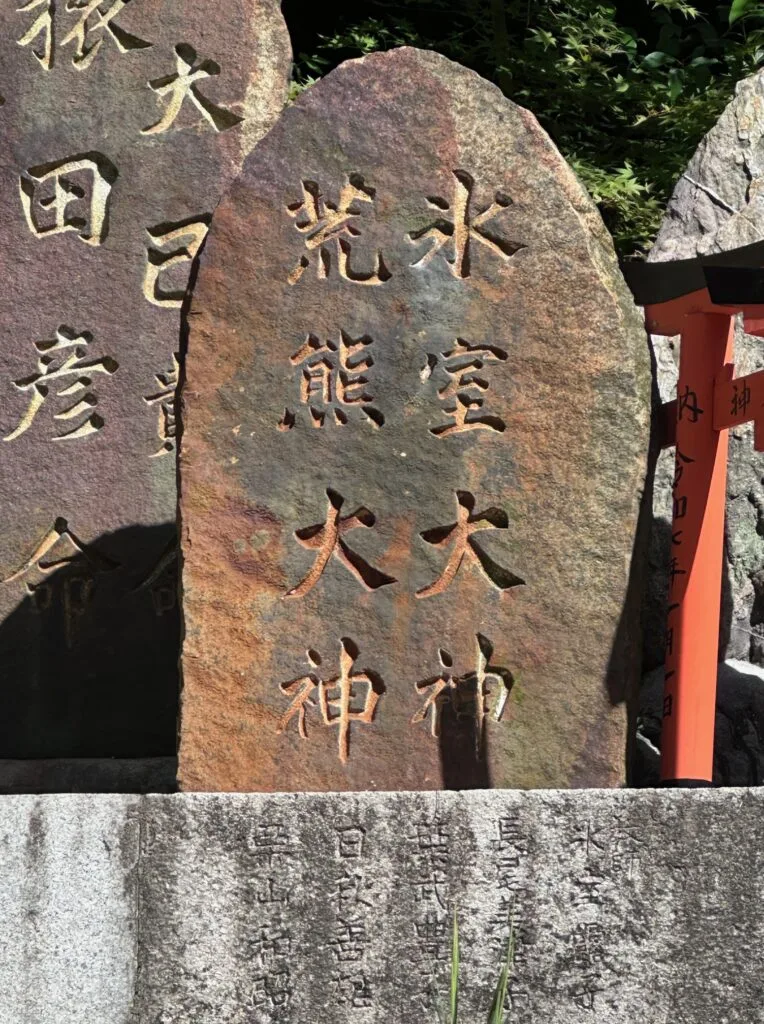
The crowds are gone now. The path passes a few groves, a jumble of otsuka stone markers, carved with the name of gods.The sheer number of markers that dot the forests of Mt. Inari is a testament to shinto’s infinite “eight myriad gods,” though many of the names have been perhaps lost to all but the memory of the most elderly. Japan’s spiritual past once had an abundance of gods, many regional or simply local, honored only by a few. As the nation industrialized and systematized in the early 20th century, the Meiji Government’s Shrine Consolidation Policy dramatically reduced their number, creating a sort of “greatest hits package” of gods, with the same dozen or so seemingly everywhere. It is always great fun puzzling out the names of these former gods, some with names frighteningly wrathful.
Here and there, plum blossoms are just beginning to come in to bloom. The path passes a terraced stretch, then arrives at a junction. Continuing left uphill brings the walker to Mt. Inari’s peak, to be followed by a descent to the Crossroads Observatory, from where you can return again to the shrine below, or take the Isshu Trail’s Higashiyama section, moving diagonally down toward Tofuku-ji.
I instead turn right and stay with the Fushimi-Fukakusa course, curling around a beautiful old home before entering the lower reaches of the bamboo forest. The forest has ancient roots, the setting for Japan’s earliest prose narrative, The Tale of the Bamboo Cutter, written around the end of the 9th Century. I pass a woodsman and ask him about the numbers spray painted onto many of the trees, which he confirms are simply dates from the Reiwa calendar, indicating their time of planting. I had presumed that the terracing of these forests was due to carving away terrain clogged with the roots of old trees. But I’ve overthought it, as he says that the dirt there is simply dug away in order to cover up new plantings.
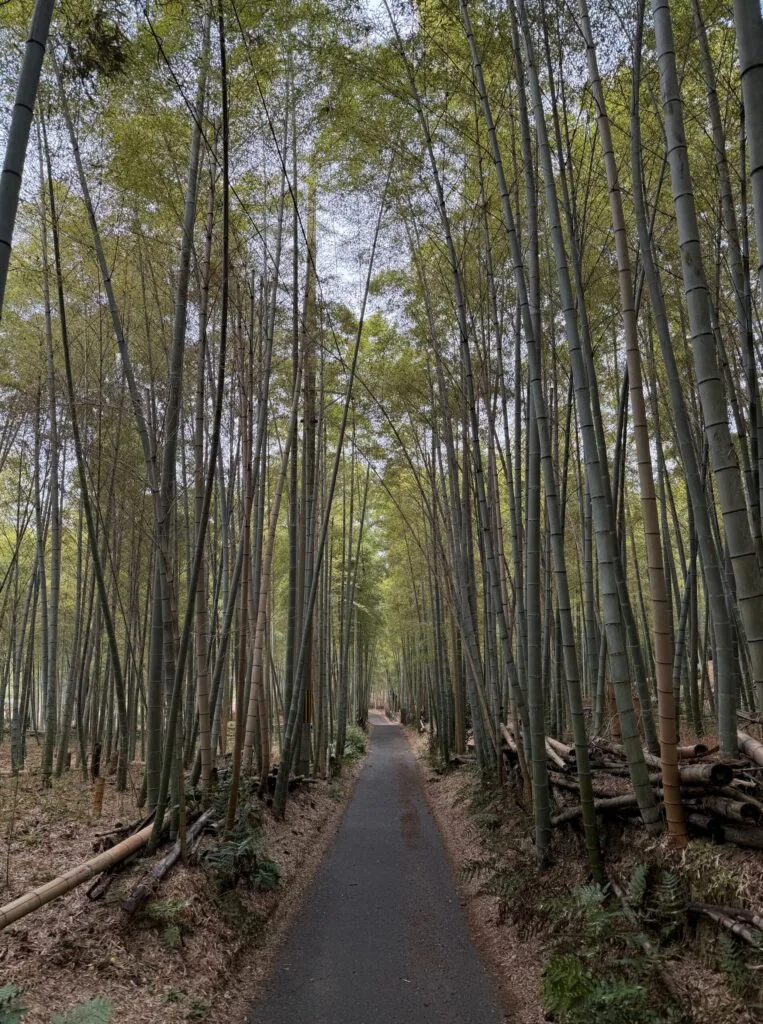
Upon leaving the edge of the mountain, I am completely alone. When the bamboo lets up, a few couple vegetable plots appear, the winter vegetables looking strong and healthy, with newer plants coming in.
This broader valley is full of sun, which brings more quickly the plum blossoms into maturity, a few of them already beginning to drop their petals.
The path enters suburb for awhile. Fukakusa has a gently rolling landscape of imperial tombs, many bearing names recognizable only to history buffs. The name Kanmu will be familiar to most everyone, as it was this emperor who founded Kyoto. I won’t reach his tomb until further on, but in 1821 a memorial stupa was built here in his honor, though the adjacent buildings are today in various states of collapse.
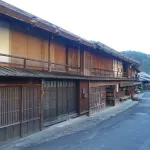
The path makes a sharp left, leading me along a pleasant stretch lined with Edo period buildings. This has all the look of an old feudal highway, but despite my digging around, I’m unable to find any history or even a name. At it’s far end, I find the entrance to Ōiwa Shrine. The path climbs steeply into another bamboo forest, the most strenuous part of today’s walk. Luckily, the climb doesn’t last long, but perhaps more worrying are the sheer number of warning signs for mamushi vipers. The signs give the impression that they’re simply everywhere. The snakes do tend to live in bamboo groves, and there certainly was plenty of that along the way. But I’ve never seen any vipers over numerous visits.
The torii gate at the base of the shrine is the most unusual I’ve seen in Japan. It has an ancient look, out of Egypt, of Greece, of Angkor, leading the walker to feel they’ve stumbled across timeless ruins. The shrine, like Fushimi Inari’s remoter shrine groves, hint at how wild prehistoric Shinto had once looked.
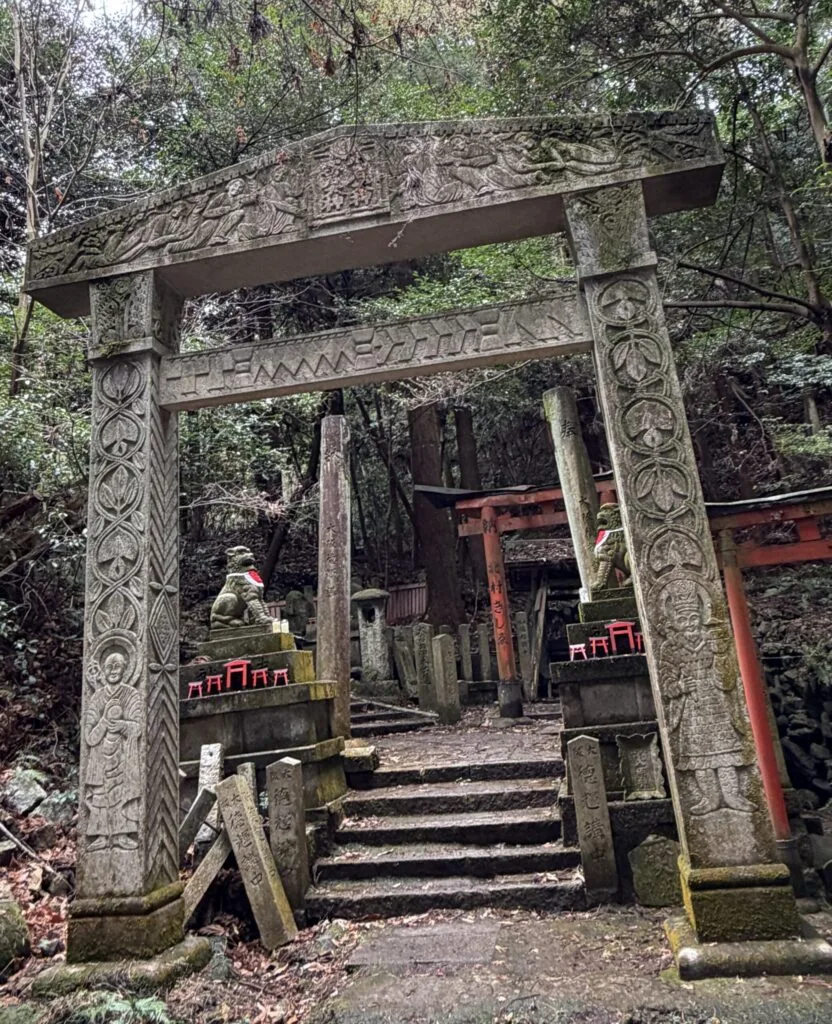
But this unusual gate is relatively modern, created by Dōmoto Inshō, one Japan’s top 20th Century painters. (A museum dedicated to his work has been built near Ritsumeikan University in Kyoto city, fronted by a gate with a look similar to this one.) The shrine is known for its power to heal tuberculosis, and the gate was apparently created by the painter as a way of petitioning the gods to cure his mother’s illness.
As I stand looking at its ornate carvings, I hear a pair of slow claps, then another. That’s my usual technique in bear country, but there are certainly no bears around here. Coming down the steps is a man who turns and claps before each of the numerous fox statues lining the path.
I climb the stairs to another Dōmoto designed gate, then offer my own pair claps to the gods embodied here. In front of the altar are a circle of stones, each the size of a fist. Shinto gods are thought to manifest in stones, and the idea that stones can give birth goes back to the religion’s most ancient roots. Perhaps these stones today are the offspring to the two large stones behind the altar, the larger of which, Ōiwa, gives the shrine its name.
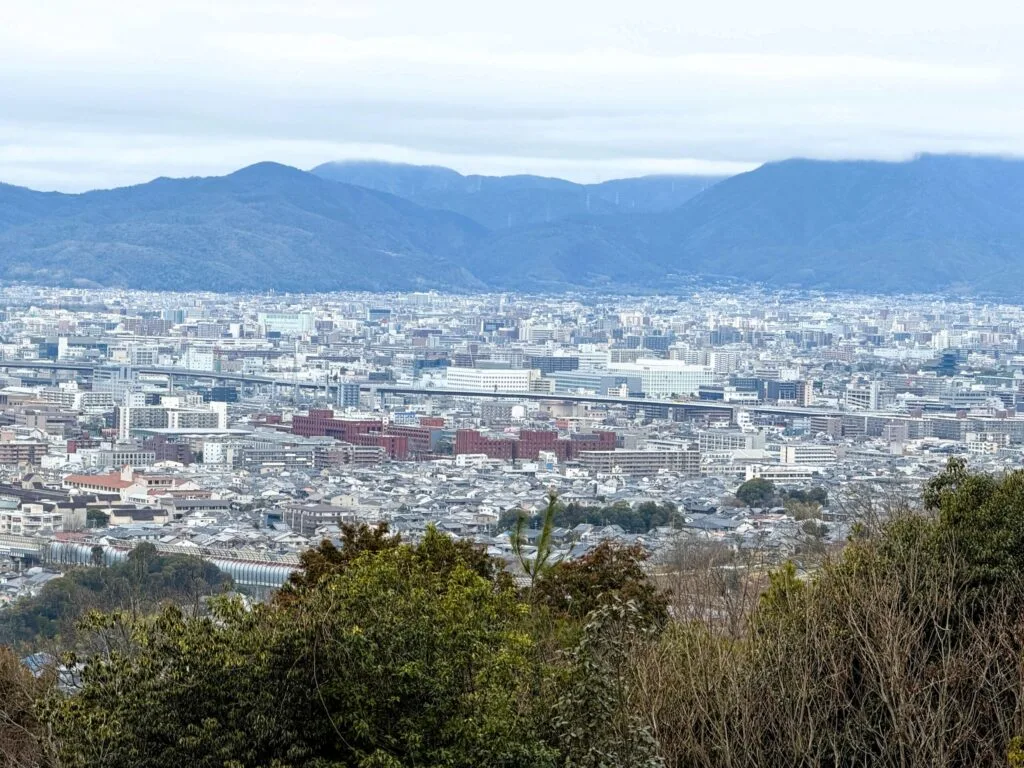
I continue uphill a short ways to a grassy overlook. South Kyoto has been called Japan’s Silicon Valley, and here it is all laid out below me, from the lone tower of Kyocera, to the twin cubes that are the Nintendo headquarters. Far in the distance, the jagged teeth of the Osaka skyline lines the gap where the hills fall away. The benches here make for a tempting picnic spot, but my lunch awaits a further hour away in town.
The trail begins to descend steeply, and it becomes apparent that this walk is more challenging from the opposite direction. This next section is pretty dire, filled with a lot of discarded industrial rubbish, and a solar farm carved out from what had once been forest.
Beyond a section of suburb, I find Fushimi Kitabori Park. The bubbling little creek at its heart must be heaven for neighborhood children during summer. Towering, grandaddy cherry trees shade the paths on both sides, likely to bloom in the next few weeks. The park is popular with joggers, whose exertions can be measured by the numbered markers hung at hundred meter intervals.
Emperor Kanmu’s mausoleum is at the park’s far end. Known as Kashiwabara Imperial Mausoleum, it was perhaps from this very spot that he overlooked the valley that became his new capital in 794, (though many claim that his vantage point was just to the north at Shogunzuka).
Fushimi Momoyama Castle looms above me as I walk its perimeter.
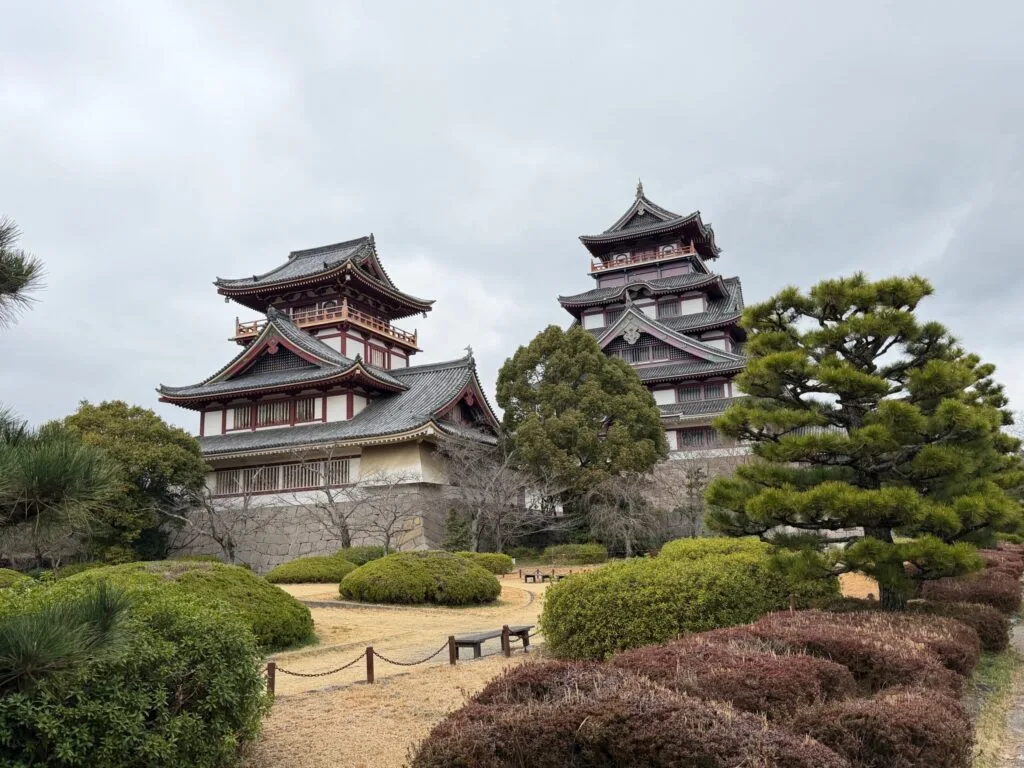
Toyotomi Hideyoshi had the original built in 1594, but it was soon after destroyed in an earthquake. Rebuilt quickly, it proved vital to Japanese history. In 1600, Tokugawa Ieyasu had it manned by a small force of defenders in order to engage and delay the encroaching army of Ishida Mitsunari, so that Tokugawa could take better defensive positions on the battlefield of Sekigahara. The strategy may have helped Ieyasu win the day, but not before all the defenders were lost in a mass suicide. Sections of the subsequently dismantled castle have been incorporated into castles and temples across Japan, most notably as the blood-stained ceilings of a handful of Kyoto temples.
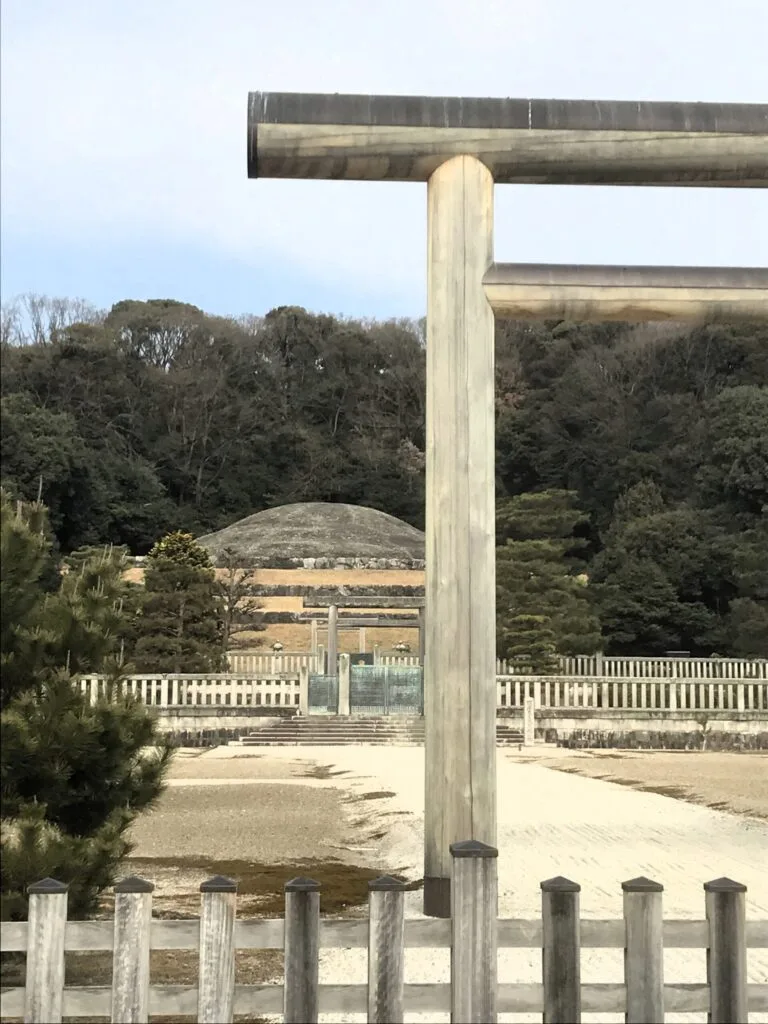
The castle’s true original location is a few minute’s walk away, where the Mausoleum of Emperor Meiji now stands. The tomb’s massive size is befitting his historical importance as the final emperor to reside in Kyoto, and I like the irony that he rests just next to Kanmu, the city’s first. His wife, the Empress Dowager Shōken is buried beside him and this hill on which they lie commands incredible views. (Ironically enough, I was denied these views on the day of my walk, as the entire area was closed off due to the visit of Prince (and future emperor) Hisahito, reporting to his great-great-great grandfather that he had completed his coming-of age ceremonies.)
Nogi Jinja stands near the base of the grand staircase that leads down from the Meiji tombs, built to deify Nogi Maresuke in in 1916. The Admiral is best known for his heroism during the Russo-Japanese War, but the shrine exists due to his (and his wife’s) junshi ritual suicide to follow his lord, the Emperor Meiji, in death.
My travels through time end as I pass from this large memorial park and into the edge of Fushimi proper. The road into town passes the stations of three rail lines, making for an easy return. But to do the walk in the morning allows the walker the opportunity to explore further. The Gokōnomiya Shrine along the way has roots well beyond the 9th century, and a millennium later served as headquarters for Satsuma samurai as they prepared for the Battle of Toba-Fushimi, which proved the definitive end for the Tokugawa Shogunate. The shrine has best known for the quality of its spring water. As such, it has always been revered by the area’s many makers of sake, whose production began to flourish due to Hideyoshi building the aforementioned castle here, and the port town that followed, sitting at the confluence of a number of river systems which allowed the sake to flow throughout the country. Forty sake breweries continue to operate today, most of them converging at the Fushimi Sake Village, where the most hardy can take on an 18-sake sampler set. But following as it does our three hour walk, to do so could cause time travel of an entirely different character.